1 John 1:9: do Christians have to keep confessing sin to stay forgiven?
From chapter 9 of No Longer I, “Blood and Atonement,” the section titled “What about 1 John 1?” It follows a discussion of atonement and sinless perfection.
This conversation almost always leads Bible-reading Christians back to one particular scripture—1 John 1. There are certainly others that are relevant, but this one has been notoriously divisive and used as an attempt to thwart the gospel of grace. It is worth our time to look at it now.
V. 7 - But if we walk in the light, as he is in the light, we have fellowship with one another, and the blood of Jesus his Son cleanses us from all sin.
V. 8 - If we say we have no sin, we deceive ourselves, and the truth is not in us.
V. 9 - If we confess our sins, he is faithful and just to forgive us our sins and to cleanse us from all unrighteousness.
V. 10 – If we say we have not sinned, we make him a liar, and his word is not in us.
As you might imagine, verses 8 and 10 are employed to destroy any argument that a Christian can be without sin. It is one of those, like Romans 7, that is ignorantly misinterpreted, taken out of context, and used to defend a position that undermines the gospel and gives power to the devil—all in the name of Jesus. These dissenters are under a satanic delusion that they are somehow “protecting the sanctity of Jesus” by insisting that he cannot sanctify, or that they are somehow “preserving the integrity of the gospel” by limiting its power. They are so intent on maintaining their doctrinal position—that is, that we are still sinners—that they have become blind to the truth that is literally right in front of them in verses 7 and 9. If you are one of these people, I assure you, the Lord will keep you blind in your sin if you do not humble yourself before him and pray that he reveals to you the plain truth within his Holy Scripture.
Look at the context, beginning in verse 7. “[I]f we walk in the light . . . the blood of Jesus . . . cleanses us from all sin.” Tell me, how can one be cleansed from sin and still have it? He does not say we are cleansed from the stain of sin, the effect of sin, or the consequence of sin. He says we are cleansed from sin itself. And not some of it, but all of it. As we discussed in the last section, this is the essence of atonement. It makes no sense whatsoever to say we have been cleansed from something if that thing still remains.
When he says in verse 8, “If we say we have no sin, we deceive ourselves . . .” he is speaking of acknowledging our depravity apart from Jesus. It is true that “all have sinned and fall short of the glory of God” (Romans 3:23). To be sure, no level of spiritual maturity—not even the state of perfection itself—would negate one’s basic need for God’s saving grace. Everyone has sinned. If we fail to acknowledge this, claiming to have a righteousness of our own, then by definition, we are walking in the darkness, not the light. But as he says again in verse 9, when we acknowledge this reality, Jesus forgives us and cleanses us from all unrighteousness. How foolish it would be, after having been cleansed, to go on believing that we are still dirty! How much more foolish to insist that this belief is essential for abiding in God when it is, in fact, the exact opposite!
It is worth noting, once again, that cleansing is something different than forgiveness. John was not being redundant in saying that God forgives us and cleanses us. His point is to express the completion of the atonement, the full removal of sin, completed for all who have turned from darkness to the Light.
Just as we cannot walk in the darkness and have fellowship with the Light, neither can we walk in the Light and remain in darkness. For “God is light, and in him is no darkness at all” (1 John 1:5). Hence, if we are truly in him, then there is no darkness in us. If I believe that “[i]t is no longer I who live, but Christ who lives in me” (Galatians 2:20), then how could I still claim to have sin in me? These two ideas are logically incompatible. If I insist that I still have sin, I would have to renounce this glorious thing that God has done. I would have to deny his grace and subdue my faith. “So you also must consider yourselves dead to sin and alive to God in Christ Jesus” (Romans 6:11).
In the next verse (1 John 2:1), John writes: “I am writing these things to you so that you may not sin. But if anyone does sin, we have an advocate with the Father, Jesus Christ the righteous.” Notice John’s explicit intent for what he just wrote—that they may not sin. Does he presume that they will sin, or does he presume that they will not? He says, “if anyone does sin,” not “when everyone sins.” Is it not shockingly clear that they had a different perspective than we do today? Should we call John a heretic for suggesting that they could actually go on without sinning? If one of his disciples came to him a month after reading his letter and said, “John, thanks to your instruction, I have not sinned!” do you think John would balk at this claim? Do you think he would yell, “Liar! Liar! The Truth is not in you!?” Or do you think he would celebrate that the man was walking in the light and that the cleansing blood of Jesus was having its intended effect?
Perhaps an analogy is needed to help us understand these verses in John a little better. Imagine that the goal was for you to get to my house. In this case, saying that you have no need for my address is like saying that you “have no sin” (1 John 1:8) or no need for cleansing, even though you most clearly do. This would be very prideful and stupid. You would simply be deceiving yourself, and you would never be able to make it here. Nor would I have a reason to give you the address under the pretense that you do not need it. But if you told me that you did not know the address, then I would give it to you. Problem solved. After receiving it, you would forever rely on the information that I gave you, but you would not need it like before, for you would have it. It would be untrue for you to tell people that you got here on your own and that you had no need for my help. But it would be just as untrue to say that you still needed my address as if I never gave it to you.
Apply this to 1 John, and you will see what I mean. To John, the person who says they have no sin is basically saying they have no need for God’s grace. But if you confess your sins to God, acknowledging your need for his grace, he solves the problem by giving you that grace (i.e., removing all your sin). He makes you clean and pure as he is. And after this occurs, it is just as untrue to say that he did not cleanse you as it is to say that you had no sin from which to be cleansed.
Here is our real problem. We have one sinful thought, and we thereby conclude that we still are not righteous. The flesh gets the best of us, and we decide that God’s word is not true. A brother acts according to the flesh, and we say, “See, you are still a sinner.” But the proper response would be to say: “Don’t be deceived. That was not who you are. Remember and believe that you have been cleansed, and walk in the truth.” We think that if you confess your sins, then you are admitting to still being unclean. But actually, confession is the very confirmation of our newness and our cleanness. It is a reaffirmation of who we truly are in Christ. It is itself evidence of our heart’s true desires, proof that he has made us righteous and pure. And if ever you are unsure about the state of your own heart, the Bible instructs you to simply confess, and you will be made clean and righteous. After that point, you must start to believe it is so.
Back to the conversation about sinless perfection, I want to be very clear about something. Please note that our flesh is not yet perfected, but its desires are gradually transformed as it is submitted to the Spirit. For its perfection, we await our resurrection body. In the meantime, its passions can still rage and wage war against us. In this sense, our perfection is ongoing work that is not yet complete. But what does Paul say? “[W]e regard no one according to the flesh” (2 Corinthians 5:16), which must also include ourselves. Therefore, we must categorically reject the idea that the flesh’s desires are our own. For to live according to the flesh (or to identify with the flesh) is to inevitably deceive ourselves back into sin, rendering the atonement practically ineffective. “For to set the mind on the flesh is death . . .” (Romans 8:6).
And there is yet another point on which I must make myself clear. It is not that we should take no responsibility for our sins, nor that we should think it is impossible for us to sin. Rather, we must accurately identify the source of our sinful passions and, in the case that we do sin, why it happened. If our spirits have been renewed, then sinful desire comes from the body of flesh, and the reason for sinful action is deception. If we sin, it is not because we truly wanted to do said thing but because we were deceived into identifying with the passions of the flesh. And if we have any doubt at all whether our hearts are truly pure, we can purify them in an instant with simple faith in Jesus, setting the intent of our hearts on him, which is true repentance.
There is no need for guilt or condemnation, only a need to think better and grow in faith. We are “transformed by the renewal of [our] mind[s]” (Romans 12:2). In this sense, also, we have not yet been perfected, for our minds still need to be renewed. But that being the case, it is not so much that we have been defiled but deceived. We have not been in sin but in infancy. We have not been evil but ignorant. We have not been wicked but weak. We have not been complicit but gullible. I am speaking, of course, to those who have already been cleansed by the blood. We do not need more cleansing now; we need more faith. And those who willfully continue in deception prove themselves to be transgressors (see Galatians 2:18).
Whether or not sinless perfection is attainable in this life, at least in the sense that we have meant it for so long, may not be as important as we thought. It is true that sanctification is a process in one sense, for we must mature in our thinking (or grow in faith) to walk by the Spirit and put to death the deeds of the body (see Romans 8:13). But the process will never happen (let alone be completed) if we are not focusing on the finished work of Jesus, who has already cleansed us, removing sin from our hearts. This is the reason we have been lacking in the spiritual fruit. We will never bear the fruit of righteousness if we do not believe he has made us righteous. “For whoever lacks these qualities is so nearsighted that he is blind, having forgotten that he was cleansed from his former sins” (2 Peter 1:9).
Make no mistake. You cannot walk in the Light if you are walking by sight. Believe that you are clean and righteous by the Spirit of God within you, and see for yourself how this transforms your daily life.
From No Longer I: The Life-Changing Power of Simply Believing the Truth by Jacob Hotchkiss, © No Longer I Media LLC. Reproduced by the author.
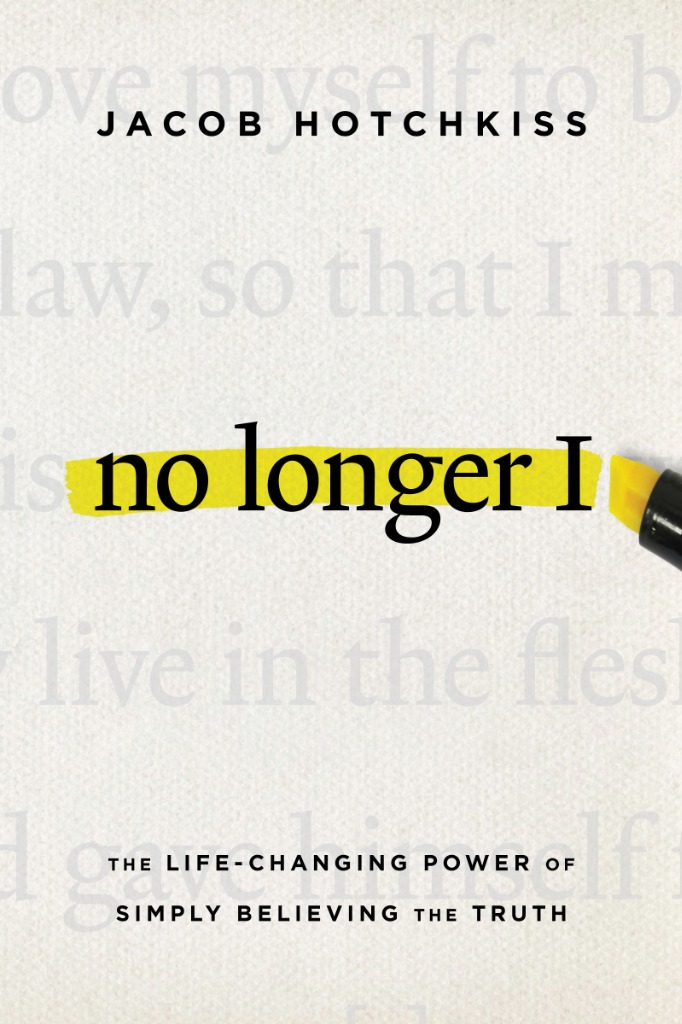
Keep reading
Read the whole chapter free, or get the book.
Every chapter is on Edify, free. No Longer I is available in paperback, hardcover, Kindle, and audio.
Read No Longer I free, chapter by chapter.
Every chapter of No Longer I is on Edify, free. Unless God Builds It is being released there chapter by chapter. Subscribe and the first thing you'll get is Rewired by Prayer, a five-day devotional on renewing your mind through the Lord's Prayer.
No paywall on the writing. A paid tier exists for those who want the monthly community call.
Other questions the book answers
- Galatians 2:20 explained: what “no longer I who live” meansChapter 4
- Union with Christ: what it means to be one spirit with himChapter 4
- Romans 6: what “consider yourselves dead to sin” means in practiceChapter 5
- Why do I keep sinning as a Christian? The story of my besetting sinChapter 3
- Romans 7 explained: is Paul describing the normal Christian life?Chapter 2
- What “identity in Christ” actually means: the mirror in James 1Chapter 4
- What is “the flesh” in the Bible?Chapter 10
- Overcoming depression as a Christian: where the depression actually livesChapter 13