Why do I keep sinning as a Christian? The story of my besetting sin
From chapter 3 of No Longer I, “A New Kind of Effort,” the section titled “My Besetting Sin.” Jacob tells his own story.
For a long time in my life (on and off for 15 years), I wrestled with a pornography addiction. It was what I would call my “besetting sin.”
It felt like I had tried nearly everything to be free of it—prayer, confession, repentance, accountability partners, accountability software, self-help books, group studies, etc. I truly wanted to be free; I despised this sin. But it seemed like no matter how hard I tried, even if I was able to keep it at bay for weeks or months at a time, I always fell back into it. And even when I was temporarily “pure”, there was still a constant battle with lust going on in my mind. The best anyone could tell me was to try harder or to stop trying so hard. The former never worked, and the latter did not sit well with me.
I had been desperate for a solution for years, and one day, before I ever learned the gospel the way that I teach it in this book, I came across a simple practice that would change me forever. It was a wonderful piece of wisdom for building faith and praying more effectively. It goes like this. When you ask the Lord something, only say please once. Then, as you continue praying, start saying thank you. It may sound a little presumptuous, or perhaps too bold, but it is grounded in an amazing biblical promise: “ask, and it will be given to you; seek, and you will find; knock, and it will be opened to you” (Luke 11:9). And, “whatever you ask in prayer, believe that you have received it, and it will be yours” (Mark 11:24). And, “If you ask me anything in my name, I will do it” (John 14:14). Etc.
Saying thank you for something you’ve asked for (before you appear to have received it) is a simple way of putting your faith into practice because, in order to say the words sincerely, one must put their trust in God. In this way, it trains the mind to trust in the Lord—his word, his promises, his provision, his love, his goodness, etc.—despite everything else telling us to think otherwise. If you have never prayed like this before, do not be surprised if it feels insincere at first. In this case, your unbelief is being exposed. Praise God that he is bringing it into the light so that it can now be dealt with.
Some are opposed to this kind of prayer, but it should be quite evident that their contention is with Jesus, not me. I am simply taking God at his word. Perhaps they think it misleads people to pray for things that are not in God’s will. Yet I would propose, for starters, that there are some things we can be entirely certain are always within God’s will, and we ought to pray for them boldly and expectantly. One of these things is freedom from sin, which, in this story, happened to be the content of my prayer, anyway.
So when I learned about this new way of praying, I immediately applied it to my addiction. One day, for probably the ten-thousandth time, I prayed, “Lord, will you please free me from pornography forever?” And then it struck me—I would never again ask God to free me from this addiction. Committed to this new prayer of faith, I said (maybe for the first time ever), “God, thank you that you will(?) free me from pornography,” a little unsure of how far I could push it. And then two things happened.
The first is that I felt a surge of hope. I felt encouraged to finally stop agreeing with the defeatism and despair that had defined this struggle for so long, and simply to trust in God again as the real and imminent solution to my problem. This was exciting. But the second thing that happened was even a little more interesting. I continued to pray this way for a couple days—thanking God that he would do it *eventually—*until a very peculiar thought crossed my mind, which I think came from the Holy Spirit:
When will I ever be able to confidently say, “God, thank you for setting me free?” When can I ever be sure that the work was really finished? After a week of purity? No, that’s probably not long enough. After a month of purity? I had gone that long before without watching pornography but still fell back into it. After 6 months of purity? Maybe, but still, I’m not so sure. How about 10 years of purity? Hold on, isn’t it always at least possible for me to stumble again?
Then, in that moment, I realized how foolish of a prayer this was—that God would eventually set me free from this sin, as if I wasn’t already free from it (just like my Bible says). The fact is, whatever magical moment I was waiting for was not in my future but in my past, when I was baptized into Christ and born again. I am either free now or free never (at least in this life). And so I prayed a new prayer once more: “God, thank you for setting me free from my addiction to pornography.” Honestly, when I prayed this, I did not even know how it could be true. It did not make sense to me. But I knew it had to be true and that I had to believe it in order to begin walking in it.
Moving forward, whenever I prayed about this subject, I resolved only to give thanks and praise to God for his perfect deliverance and my total victory, regardless of how I felt about it that day. This was in contrast to the way I had prayed in the past, continuing to ask for it and waiting for explicit evidence to confirm I had received it.
To my delight, it did not take long for me to start believing that God had set me free, the fruit of which was that I began to experience victory over sin. Without even knowing exactly how, I was beginning to walk in the victory that had been mine all along. As I came to learn, this was not so much an answer to prayer as it was the result of my faith. It was not necessarily a new outpouring of grace but an application of the grace which had always been available to me. I had just never accessed it because I never had the faith to do so. The deliverance I had prayed for regarding my addiction had been accomplished long before I ever prayed for it, through the death and resurrection of Jesus Christ. I simply had not been walking in that grace until I began believing that it was there.
In other words, I had been enslaved to sin (although not really) only because I believed I was. Every time the flesh barked at me with its temptations—say, with an impure thought or a powerful feeling—I believed the narrative that I still needed deliverance, that there was still something wrong with me. As a result, feeling defiled by the temptation itself and weighed down by the seeming inevitability of failure, I was unable to draw near to God and rely on him for help, left alone in my own strength to keep from sinning. Then when I failed, it reinforced the belief that I was still under the power of sin, and I continued living under oppression. Thus, my supposed identity as a sinner compounded my sin. Sound familiar to anyone?
In my mind, I thought that I needed hard evidence before I could claim total freedom. I was always looking to string together months or years of purity to prove that I had overcome this sin. But of course, this is the very mindset that kept me imprisoned for so long. The solution? Look only to the Cross. The moment that I found confidence in my victory through the finished work of Christ, according to the word of God rather than anything else, is the moment that sin stopped being able to control me.
In the months after this revelation, I relapsed a couple of times, but these instances were not like the rest, for one explicit reason: Afterward, I did not let the sin define the truth (because sin, in essence, is a lie). I did not let it convince me that I was yet to be free or victorious. Instead, I simply realized that I had been duped. My flesh came knocking at the door, and I momentarily believed the lie that it was still me. Once I came to my senses, all I needed to do was look back to the Cross to confirm the truth, walking out of it once again a perfectly free man, giving thanks to God through Jesus Christ that I had been made new.
In all honesty, this was not as easy to do as it is to retell. Believing in the face of lies takes conviction, trust, persistence, and effort. But the effort is in believing and walking in what God says is true, rather than striving to make something true which is yet to be. The two are very different.
The flesh (and Satan) will come on strong at times, making a superbly convincing case that we are still in sin, that we have not yet been made new. We may think to ourselves, “If I am truly free, then why am I still being bombarded with all these fleshy thoughts and feelings?” We may think that because there is an ongoing battle, there is not yet victory. But then we have misunderstood the situation. The victory is ours; we are truly free. We must now fight to believe it. Our freedom is perfect; our faith is not.
Along the way, we might find ourselves in times or seasons of weakness, where we have fallen into the trap, believed the lie, followed the flesh, and given into temptations of all sorts. Does this mean that we are still our same old sinful selves? By no means! Does this nullify the grace of God or undo the work of Christ, which is received through faith alone? Absolutely not! It means we were lied to; we were gullible; and it is time now to plant ourselves firmly in the unchanging truth of the gospel, as opposed to the always-changing state of the flesh. It is time to “put off your old [man], which belongs to your former manner of life and is corrupt through deceitful desires, and . . . be renewed in the spirit of your minds, and . . . put on the new [man], created after the likeness of God in true righteousness and holiness” (Ephesians 4:22-24). This is true repentance—putting off falsehood and putting on Truth; believing in the unseen reality, despite what we see.
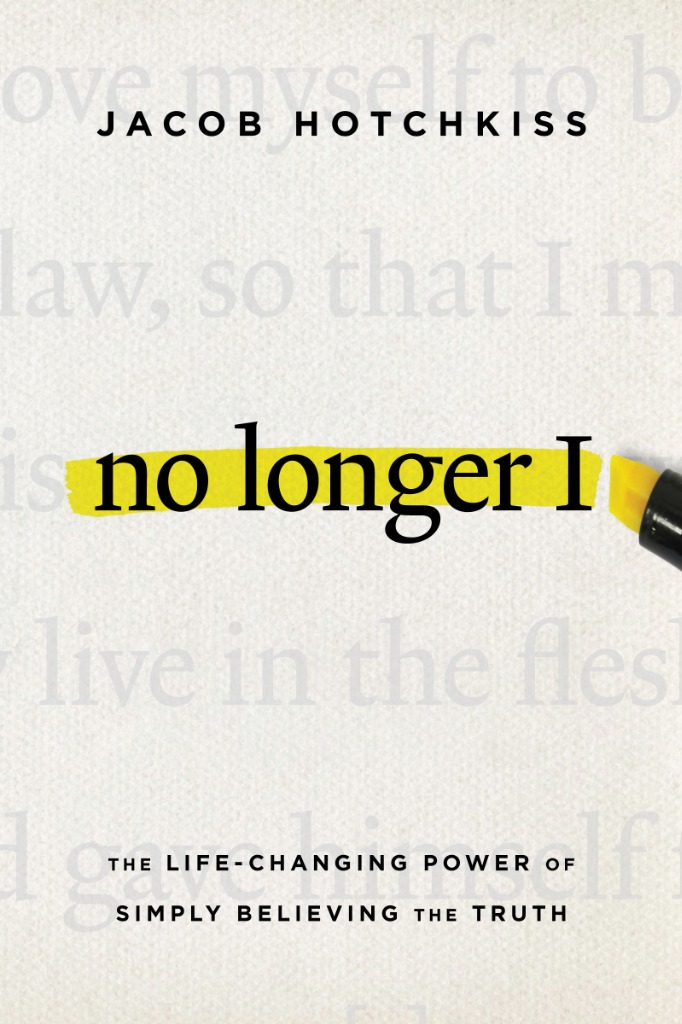
From No Longer I: The Life-Changing Power of Simply Believing the Truth by Jacob Hotchkiss, © No Longer I Media LLC. Reproduced by the author.
Keep reading
Read the whole chapter free, or get the book.
Every chapter is on Edify, free. No Longer I is available in paperback, hardcover, Kindle, and audio.
Read No Longer I free, chapter by chapter.
Every chapter of No Longer I is on Edify, free. Unless God Builds It is being released there chapter by chapter. Subscribe and the first thing you'll get is Rewired by Prayer, a five-day devotional on renewing your mind through the Lord's Prayer.
No paywall on the writing. A paid tier exists for those who want the monthly community call.
Other questions the book answers
- Galatians 2:20 explained: what “no longer I who live” meansChapter 4
- Union with Christ: what it means to be one spirit with himChapter 4
- Romans 6: what “consider yourselves dead to sin” means in practiceChapter 5
- Romans 7 explained: is Paul describing the normal Christian life?Chapter 2
- What “identity in Christ” actually means: the mirror in James 1Chapter 4
- 1 John 1:9: do Christians have to keep confessing sin to stay forgiven?Chapter 9
- What is “the flesh” in the Bible?Chapter 10
- Overcoming depression as a Christian: where the depression actually livesChapter 13